
In the Still, Dark Quiet
To be alone with God is a gift beyond words.
Any given Sunday, I awake at 5 a.m. I tend to Fiona and the rodents and the quail. I eat breakfast, shower, dress, and head to church. The drive along US-131 and I-196 is typically devoid of other motorists, so my journey is swift.
By 6:15 or so, I pull into the parking lot at St. Anthony. I drive around back, looking for signs of night-time evildoers. Then I park and unlock the church door.
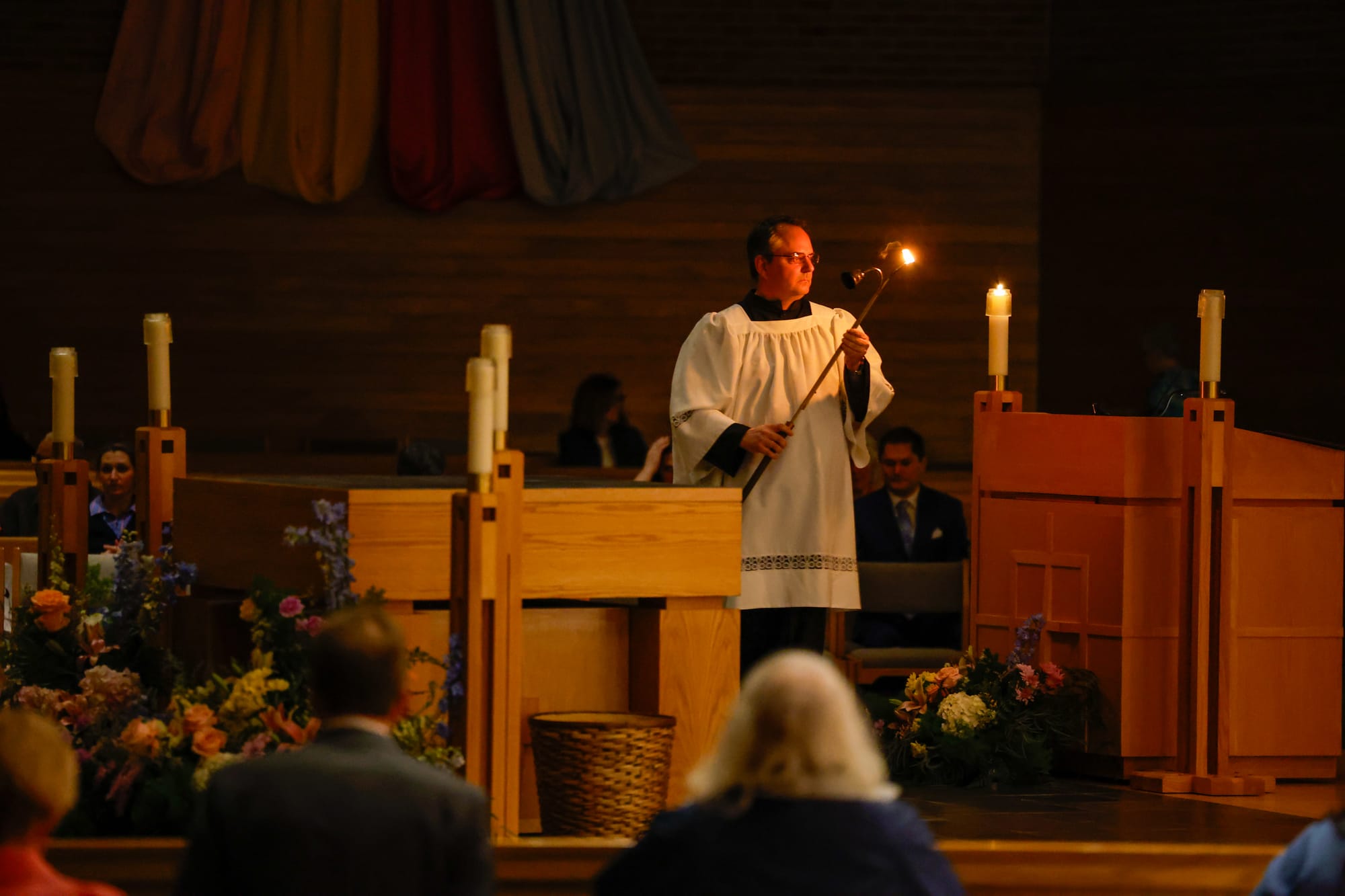
For the next 40 minutes, I perform the set-up duties of sacristan. At my church, the sacristan is an all-rounder: we are traditional sacristans, attending to vessels and candles and vestments; we are sextons, unlocking doors and responding to facility security and medical emergencies; we are liturgy coordinators, ensuring that all the assigned lay liturgical ministers are accounted for and properly instructed; and we are masters of ceremonies, directing the lay volunteers and guiding visiting clergy — usually informally but sometimes in cassock and surplice in the sanctuary.
Most Sundays, I cover all three of our Masses. I generally don't leave until around 1p or later, depending on whether there are individual baptisms after our 11:30 Mass. I'm the first one in for the weekend, and the last to leave. And during the middle, it's an often chaotic blend of attending to the sacred vessels, making sure everyone's where they need to be, and answering questions from my fellow parishioners.
It's not a ministry for the absentminded, the introverted, or the easily annoyed. And although it can be a bit extra, there are bits of it — like my opening and closing practices — that definitely draw me closer to God.
I started as a parish sacristan around 1998 or 1999. I was but a wee lad, putatively on a seminary track. In those days, my parish was in the custody of the Order of Friars Minor; one of the friars — Fr. J.R. — had been nudging me to be a Franciscan but I didn’t gel with that order’s charism.
St. Anthony had been my home since I was in the first grade. Although I was baptized elsewhere and spent my high-school years at my baptismal parish, St. Anthony had always been home. I attended the parish school through the eighth grade, before heading off to West Catholic High School. When I studied at Western Michigan University, the Kalamazoo-area parishes never really felt right: St. Tom’s was too oats-and-granola for my taste, and St. Augustine smelt of Ben-Gay and dessicated flesh. So I stayed at St. Anthony even as I felt the first stirrings of a potential vocation.
My life did not include priestly ordination, but the multi-year experience with the diocesan vocations office earned me some friends and allies who encouraged me to grow through various forms of service to the Church. So for quite some time, I volunteered as a hospital chaplain and as a prison chaplain. I served as a master of ceremonies to the then-bishop, Walter Hurley. I supported the diocesan Office of Worship as part of a team holding Art & Environment trainings at different parishes.
My seminary journey ended on a sour note; I wrote about that in an essay published in Christ’s Body, Christ’s Wounds edited by Eve Tushnet. I still did “all the things” after that but it was different. Not better, not worse — just different.
Eventually the Franciscans left. A new pastor arrived. I ultimately left the parish, spending a bit of time wandering the wilderness of acedia before doing a bit of parish hopping. First at St. Robert as an OCIA sponsor, then at Sacred Heart and St. Isidore. Burnout is a heck of a thing.
My grandmother died in the summer of 2024. She attended my baptismal parish, St. Mary’s (Marne). But funny thing — all the St. Mary’s team were on vacation the week of her funeral. So who should swarm me and my family but my old St. Anthony people. I took it as a sign and eventually re-joined the parish.
These days, the world at St. Anthony is a bit different. Our current pastor is a thoughtful fellow who never seems to get his feathers ruffled and does not seek the spotlight. He cares about the little things: I recently helped him locate the spots on the church walls where the church building had been anointed during its dedication Mass in 1994, so he could install candles for the anniversary of the dedication. For 32 years, no one cared; he cares, now.
I did not originally rejoin seeking to return to my sacristan role. I planned to just sit in the pew like everyone else, but our deacon — a good recruiter! — had other plans for me. So I started supporting funerals, and then I helped one sacristan with a bad back on his assigned weekend.
This past February, I ended up being responsible for the three Sunday Masses on every weekend but the first, plus backup support on the first weekend. I also take the third Saturday of the month. It’s a lot, but for now, it’s not too much, although I’m certainly eager to train the next generation and let others lighten the load.
Spiritually, I’m in a different place. I view lay ministry as a form of service and not a form of identity. My prayer life has intensified — as a “medieval contemplative” (as a former spiritual director once characterized me) I pray at least one major hour of the Liturgy of the Hours most days of the week, and I especially enjoy the Office of Readings.
But for now, I have a standing 5 a.m. alarm every Sunday. That alarm summons me to the most intense and meaningful prayer I experience each week.
There is something sublimely beautiful about pulling into church this time of year. The sun isn’t up yet, but you can see it stirring. One must drive carefully on Richmond given the proliferation of deer.
The church is like a tomb, silent and dark. The sun will be up soon — but not yet. That still quiet reminds me of Easter Morning at dawn: A miracle has occurred but the word hasn’t yet spread. To be there is to feel the anticipation of the Resurrection. Silly as as it may sound, the church is intimidating. You know what’s coming but it isn’t there yet. Not until the Mass celebrates that first Easter anew.
The church — which will be so bright and busy in just an hour — invites me to pray as I do my liturgical chores. Yes, we all bow to the altar during Mass. But often, these signs are perfunctory, done by rote while one’s mind is focused on the next thing in the Missal.
But when it’s dark and quiet, and I reverence the altar of the tabernacle, I feel more conspicuous because I feel seen — not by my fellow parishioners, but by God. I feel the same thing every first Friday of the month, when I participate in Adoration at Sacred Heart. In previous years, I had the midnight-to-2a shift, and it wasn’t uncommon for me to have an occasional hour alone. I am aware of my posture, my position, and my disposition in a way that I’m not at any other time of the week.
When my chores are done, I step outside. The sky this past weekend was gorgeous, pastels at the horizon anticipating the dawn. I sip coffee and welcome the first folks to come in for the 7:30 Mass. My quiet time is over; my role transitions from prayerful preparation to liturgical project manager. But it’s OK. I’m at peace.
To be alone with God isn’t easy. At least, not for me. There’s nowhere to hide, and no busyness to help me pretend He isn’t watching.
We all get close to God when we receive the Eucharist. But I’m blessed to enjoy another moment of closeness, in the still dark quiet of His church.
And David went in, and sat before the Lord, and said: Who am I , O Lord God, and what is my house, that thou hast brought me thus far?” 2 Samuel 7:18