
Sandan, and Other Things
Being excellent means continuously working on the basics, no matter where you're at in the grand arc of life.

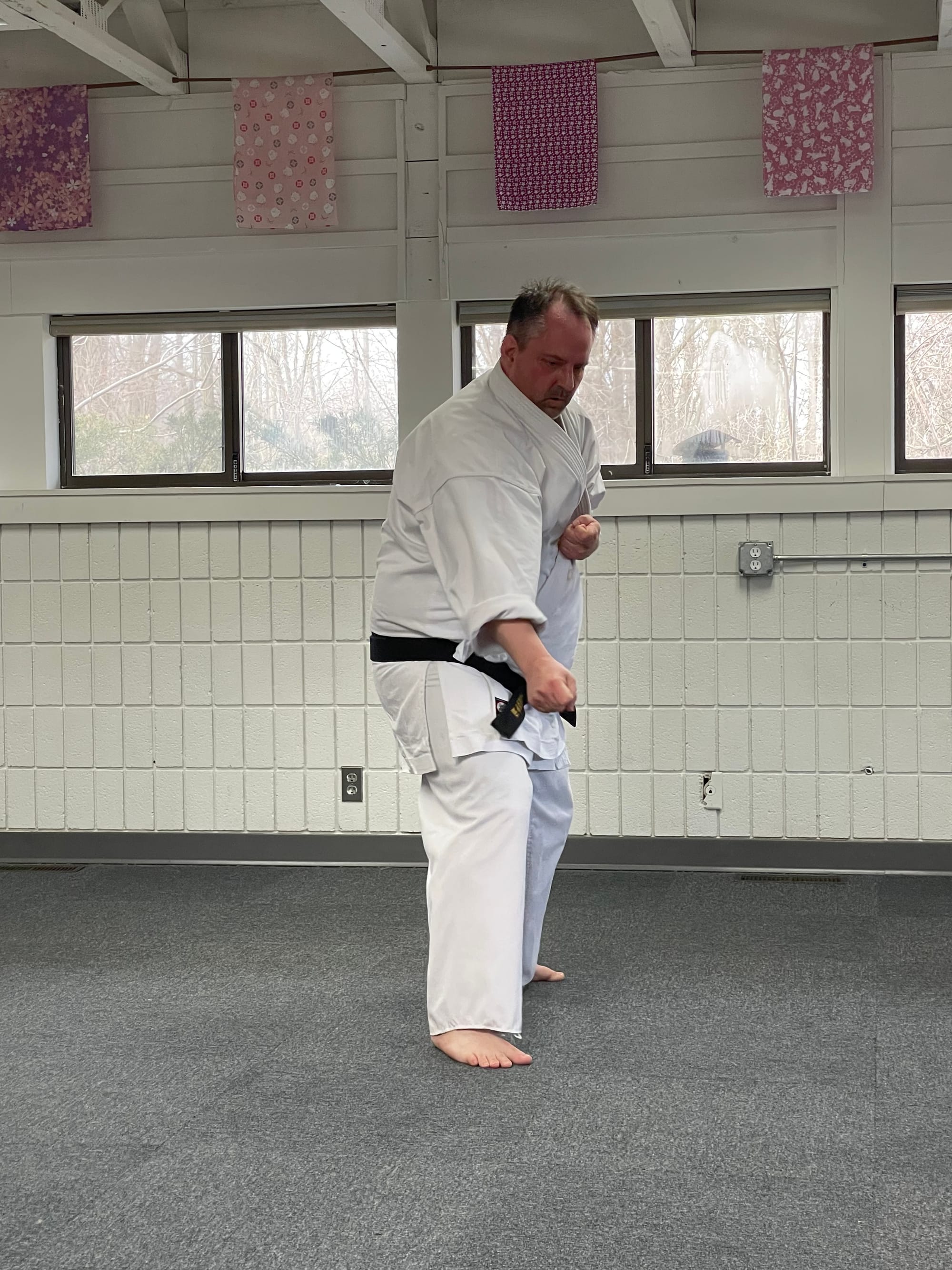
Yesterday, I successfully tested for sandan (third-degree black belt) in Uechi-ryu karate, an Okinawan half-hard/half-soft martial art that emphasizes rootedness and simple but well-executed forms.
We have a saying: our style is simple but not easy. Our progression pathway highlights as much: it takes two to three years to go from white belt to first-degree black belt. But it's not until you're a second-degree that you start to realize that you're starting all over again, but this time you know what to look for. By the time you test for fourth degree — the last "physical" test in our system; fifth and higher requires no new material but rather is a test of refinement and leadership — you're expected to have adapted the rote drills of your early years into an art that's uniquely your own.
But here's The Thing™ — you can't make an art out of life if you can't tell your right foot from your left foot.
Put differently: Continuous improvement requires a building upon basics that one masters, but for which the lessons stay mastered.
In karate, it's so easy to go from one skills test to the next, of learning this technique then that technique, and doing enough refining to "pass" a test at a lower level. But when you get to a higher level, if you haven't skilled up that technique, you can't bridge into more complex forms of mastery. I had this problem with my feet. My "rear" foot would pronate and I didn't have the biofeedback signals to correct it because I'm hyperflexible below the waist (not that you'd know it from Saturday's picture). This is normally the kind of thing we try to drum out of students earlier in their study, but I never really figured it out. So I spent a lot of time over the last few months in private classes, trying to correct basic form-and-structure gaps that were adversely affecting my ability to execute more complex techniques.
Turns out, everything in karate is connected to something else. A technique in one place manifests in some other place, so screwing up one fundamental thing destabilizes the entire foundation of training.
Organizations suffer this fate when they fail to shore up lessons learned from five-whys or root-cause analyses, by the way.
Why did the building burn down? Because everyone thought someone else was going to call 911. Why didn't we have an automated system? We did, but when we laid off the maintenance guy it broke and we never fixed it. Why didn't we fix it? Because no one understood what the maintenance guy did. Why didn't anyone understand? Because maintenance rolled up to finance and the director of finance can't tell a mop from a broom. Why did we have such a wonky reporting structure? Because we wanted to save money on managerial salaries so we gave some C-suite leaders dual portfolios. Solution: Let's get the finance director involved in creating a new maintenance position.
For individuals, the basics look a lot like this:
- Get adequate sleep. Like, seven to nine hours that are consistently scheduled. And plan your day's major investments according to your circadian phase preference.
- Get 10 to 15 minutes of early-morning sun. Use that time to read or meditate or pray, or otherwise recover from stress. The Vitamin D and the downtime are good for you. (Fellow Catholics, did you know you can combine the Office of Readings and Morning Prayer in just 15-20 minutes?)
- Walk daily – get 7k to 10k steps in.
- Do resistance training, a couple times per week.
- Drink plenty of water.
- Eat a diet of low-processed foods and ensure you're getting adequate amounts of protein (~1g per pound of body weight, daily).
- Don't smoke, and don't drink alcohol. (At least, not regularly.)
- Build and sustain social connections and nurture a sense of purpose that requires the engagement of others.
- Do something meaningful to improve yourself, for at least a couple hours each week. Reading? Hobbies? Check. As long as it's not a passive activity, like watching TV, you're good.
- When something's wrong, fix it — pursue preventive care for medical and dental problems, and psychosocial care for emotional stressors.
Life is fast. It's complex. But if you don't refine the basics, you will get only so far before your foundation becomes unstable. It might not be obvious at first, but eventually, you'll hit a wall you cannot surmount.
For example, I sometimes struggle with task management. The issue isn't cognitive; I have a well-developed NotePlan system that works well for me. The problem is usually end-of-day exhaustion. So why am I exhausted? Because my diet could be better, my sleeping could be better, and I'm not exercising like I should.
I know this. It's a fixable problem. But much like my wonky rear foot, it's vexing to fix something so basic when you're focused on something bigger. After all, why should I go to bed early when I could just sit back and watch one more episode of that new show I'm watching? Why should I get morning sun when I'm going to be late for a meeting?
Why, indeed?